Mathematics can most definitely be a headache to many people, including myself. However, it is impossible to evade as almost every field of study uses mathematics as a stepping stone within their field. On the other hand, mathematics is also a subfield of theorems, proofs, and conjectures that can be deemed beautiful. Today I wanted to introduce a problem in mathematics with no intuition. It’s been a problem that has long been worked on for many years, yet there is no feasible explanation for why this system occurs the way it does. It is called the Collatz Conjecture.
The rules are fairly simple, pick any number \(N\) and apply these two simple rules. If your number is even (\(N%2 == 0 \)) then you divide your current number by 2 (\(N/2\)) and if your number is odd (\(N%2 == 1\)) you multiply your current number by 3 and add 1 (\(3N+1\)). You would think that there would be a positive number that becomes infinite, but this is not the case ever. Every positive integer will end up in a 4-2-1 loop at some point, and no one knows why? Here I have generated a plot that shows the iterations of the first 100,000 numbers on the number scale.
1
2
3
4
5
6
7
8
9
10
11
12
13
14
15
16
17
18
19
20
21
def collatz(n):
   if n == 1:
       result = [1]
   elif n % 2 == 0:
       result = collatz(n // 2) + [n]
   elif n % 2 == 1:
       result = collatz((3 * n) + 1) + [n]
   return result

runs= N # pick a number here
seen = {}
sequence_lengths=[]
for i in tqdm.tqdm(range(1,runs)):
   length = collatz(i)
   plt.plot(length[::-1])
   sequence_lengths.append(len(length))
plt.title("First N integers within the collatz conjecture")
# plt.yscale('log') - if you want it in log-log scale
# plt.xscale('log') - if you want it in log-log scale
plt.xlabel("iterations")
plt.ylabel("number")
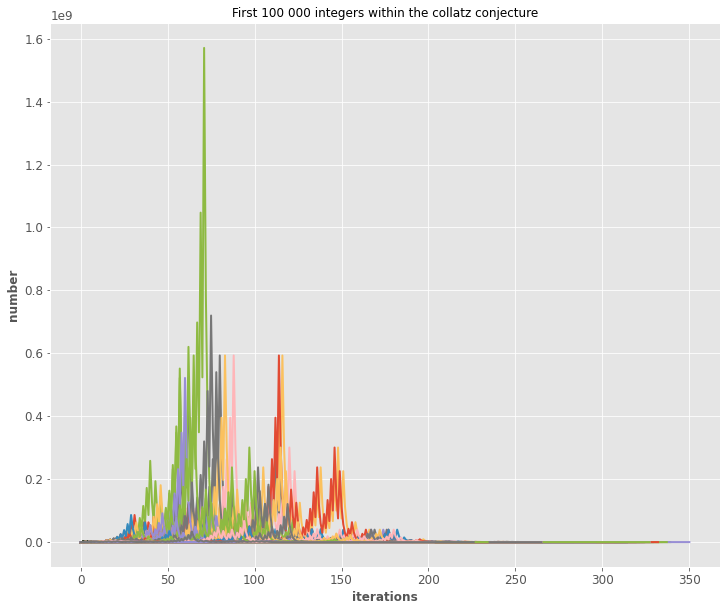
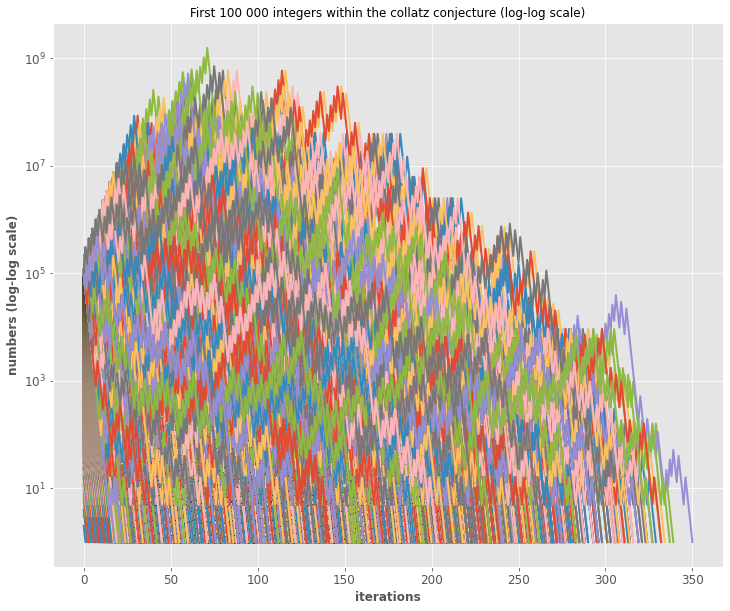
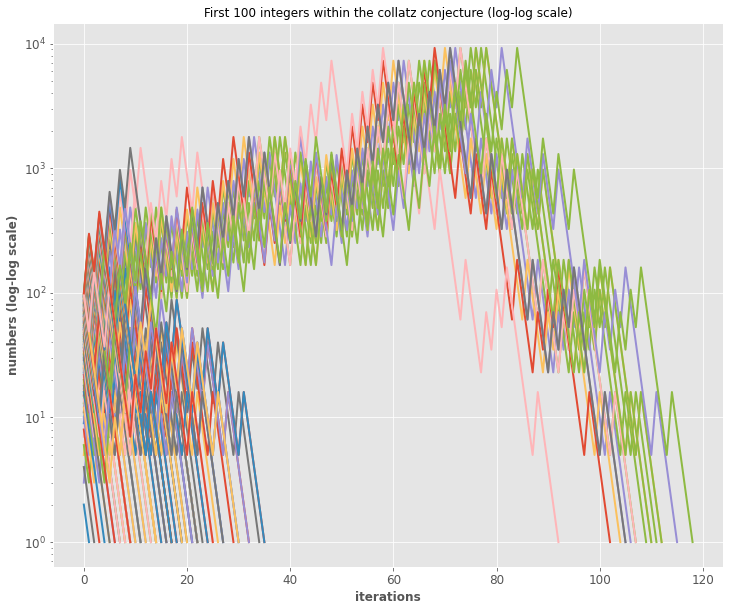
In this graph, no number surpasses 350 iterations, and most numbers don’t even reach 250 iterations. Suppose we view these numbers at a log-log scale which is a scale on which the actual distance of a point from the scale zero is proportional to the logarithm of the corresponding scale number rather than the number itself (Merriam-webster.com). In that case, we see that all numbers have almost the same trend shifted along the x-axis, which is weird.
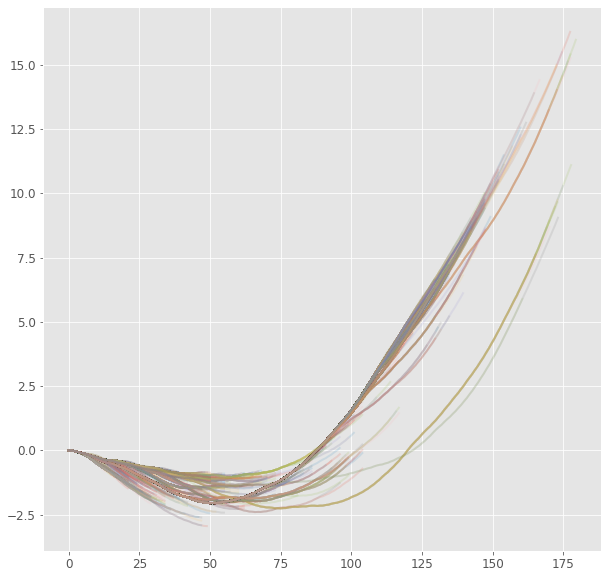
To take it a step further, mathematicians have made a new way to visualize this conjecture where you shift the number anti-clockwise if it’s even and clockwise if it is odd. With that, we get a beautiful portrayal of a feather-like structure. This is where I was talking about how beauty is hidden in mathematics.
This problem remains impossible to prove and has been something we have been told to avoid as mathematicians. Famous mathematician Paul Erdos says, “Mathematics is not yet ripe enough for such questions.” Therefore following Paul’s words, I wish to not speak any further. I hope you learned something, and I hope you have a good day.