Disclaimer
This is a challenging read because it is technical, but I tried to explain it as simply as possible. I also think this is one of the most exciting blog posts, so even if it’s hard and long, I recommend you read through the whole thing.
Introduction
I just finished watching an incredible documentary about infinity. However, it first leads to the question: what is infinity? A number, a concept, a spatial or temporal domain? I guess the answer depends on whom we are talking to. So the next question that comes to mind is can we visualize infinity? I will provide a mathematical example.
\[ \frac{1}{2} + \frac{1}{4} + \frac{1}{8} + \frac{1}{16} … + \frac{1}{2^{n}} = 1\]
If you add an infinite sequence of this given equation, you will always end up at one. If you have ever taken Calculus, you should be able to detect that this is a convergent series, which means that adding an infinite amount of numbers will sum to a finite number. However, let’s look at its counterpart: divergent series. If we add the following, we should get infinity:
\[ 1 + 2 + 3 + 4 … + n = \infty \]
Let’s take it a step further by bringing our sum and adding 1. We should get some sequence like this
\[ \infty + 1 = \infty \]
However, this is a paradox. Let me demonstrate why. If we were to subtract infinity from both sides now, we would get a famous mathematical expression:
\[ 1 = 0 \]
This makes no sense. Many things do not make any feasible sense in the concept of infinity, and it can often lead to existential spirals of thoughts. Therefore, I thought it would be interesting to present some of the things I learned from this documentary that hurt your head! So get ready to dive into some physics, permutations, and existential life as we know it.
The ∞ Hotel Paradox
Suppose we have a hotel that can fit an infinite amount of people. But first, this special hotel has some rules you should know before you proceed. The hotel is always full. However, there is also always space for new customers… So if a new customer wanted to stay the night at the hotel, everyone would move to room number \( n+1 \), where n is their current hotel number. Sounds easy enough, right? The next evening, an infinite number of people want an infinite number of rooms to stay in since the hotel always has free space. However the customers will not move \( n+ \infty \) rooms. Instead there is a even more clever solution: \( n * 2 \). So if you were in room 1, you would move to room 2, 2->4, 3->6, 4->8, and it goes on and on and on. What did you do? You freed up every odd hotel room, and now there are an infinite number of rooms for an infinite number of customers. Well done.
Some people have proposed that perhaps appending the new customers to \( \infty \) seems easier and must be more straightforward. However, the issue with this approach is that no one knows where the end of the hotel, aka room infinity, is. Therefore since it is not a finite quantity, this approach will never work. This leads us to the idea that not all infinities are the same, which we also learned in calculus. This idea of infinity is starting to become scary, and it’s only about to worsen.
∞ is small
Typically we think that infinity is a large quantity. However, let me demonstrate that infinity can also be a small quantity. How many numbers lie between 100 and 101? That’s right; it’s infinite. Suppose we visualize numbers like the data structure, stack. In that case, if we keep pushing on 0 to the top of our stack, there is an endless amount of quantities that lie between these numbers (i.e., 0.00001, 0.0000000000001,…). So how do we control infinity if it is both enormous and small?
Calculus
Calculus is complex and confusing, and it was not one of my favorite subjects in high school. However, maturing is knowing that everything that changes is modeled through calculus. Whether it’s movement, a complex system, or even how pandemics work, we need calculus to make sense of it. So based on our definition, we can use infinity to explain the world around us. After all, as a mathematician, we know that something exists if you can observe it and constrain it using a set of tools. Calculus is that tool. So let’s say we have a curve that models the position of the Earth around the sun. We can model the orbit or the curve as an infinitely discretized set of lines that give us an “orbital feature .”If we constrained our elliptic behavior to be \( n = 5 \) lines, we would have a very bumpy pentagon-like orbit around the sun. But with this infinite discretization, we can model any rotation and even curve, all revolving around our time constant. And what makes this infinite discretization awesome is that we can simplify complex systems. Take, for example, a Fourier series [1]. In simple terms, a Fourier series is an infinite number of sines and cosines summed together to form any possible waveform. Using the power of the Fourier series and the number of times it takes to get through one cycle, mathematicians have concatenated a whole bunch of different series to draw pictures using these Fourier series… simply INCREDIBLE.
What I am trying to get at is that this “bird artist” is a complex set of mathematical series, all added on top of one another. But by breaking each series into individual parts, mathematicians could figure out how to draw birds from freaking vectors! This idea of studying simple systems to explain bigger ones is a massive application in systems biology, electrical engineering, etc. Our brain is only a finite amount of space, so we need to find ways to understand large systems in more accessible terms. This simple to complex mindset has led to many significant discoveries. One is electricity which has revolutionized our world.
Where to find ∞
I’ve tried to help you visualize infinity. However, now these concepts lead to a bigger question: Does infinity exist in our physical realm? And to that, we say yes and no.
Due to its properties, physicists will often refer to black holes as a physical form of infinity. So what exactly is a black hole? In simple terms, it’s a massive hole that packs matter so tightly that nothing gets out of this condensed space. This is why we virtually know nothing about it. A visualization of these systems was best seen in the movie “Interstellar,” where physicists say its visualization is pretty accurate to the one they imagine. It has a beautiful event horizon, as seen in the gif below.
So how exactly do black holes resemble infinity? We will use Einstein’s theory of relativity to theoretically explain how these compare and what occurs inside a black hole. According to Einstein, entering a black hole will feel like you’re falling infinitely; however, this falling stage is finite. Einstein believes that at some point, you will hit the “floor” of the black hole, called the singularity: an infinite curvature in space-time where all the mass of the black hole is concentrated. The environment has infinite density, and it is catastrophic. It is so catastrophic that being here will break physics and you will become unobservable. You literally cease to exist anymore. I do not want to go beyond this explanation because the world as we know it is broken when you are in a black hole. Therefore no more questions were asked, according to Einstein.
However, a group of physicists refuses to accept Einstein’s theory and believes a Black hole is a wormhole. A wormhole is simply two distant points in time connected with a funnel shape. Therefore you can get from point to point almost instantaneously. I say almost instantaneously because there also exist things in our world that are not infinite. One of them is speed. Speed has a max value of 299 792 458 meters/sec, aka the speed of light, meaning no “thing” can move faster than this speed. So if two points were billions of light years away, they would still be constrained by the speed of light.
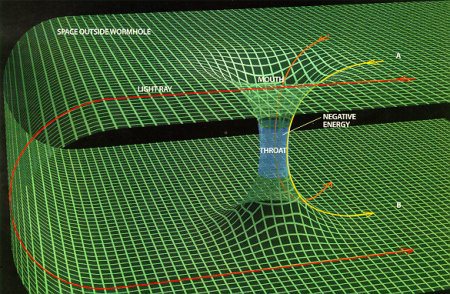 |
|---|
| Visual of the wormhole: distant spatial points connected by a funnel |
This leads us to an exciting topic about infinite time. Is time infinite? What would happen to an object in infinite time? This is where a science experiment was proposed about an object in a box. Let’s say an orange was placed in a box. Over ten days, it would begin to rot; over 100 years, it may be disintegrated into dust by the bacteria. However, based on the law of thermodynamics, the energy and the atoms within this object would freely move across the box and take different forms. For an orange of a given fixed size, it may have \( 10^{10^{24}} \) various permutations the atoms can take form as. While this is a vast number, at some point, the orange will run out of conditions it can take shape. So after an infinite amount of time, if we opened up the box, scientists believe we will have our orange, ideally in a healthy form on its own lying there.
This idea of having finite solutions within an observable space leads us to our universe.
Parallel Universes
Space is believed to be infinite. However, observable space, or a couple of galaxies that we know exist, is a finite-dimensional space. And suppose we were to view this finite-dimensional space as a composition of tiny cubic voxels. In that case, a finite amount of voxels compose our “universe .”Let’s say there were particular states or orientations our universe could be in. This idea puts a limited constraint on the number of permutation designs our universe can take form as. Therefore within the finite dimensions we know (observable space), there is a limitation of what our universe can look like. So what could make space infinite?
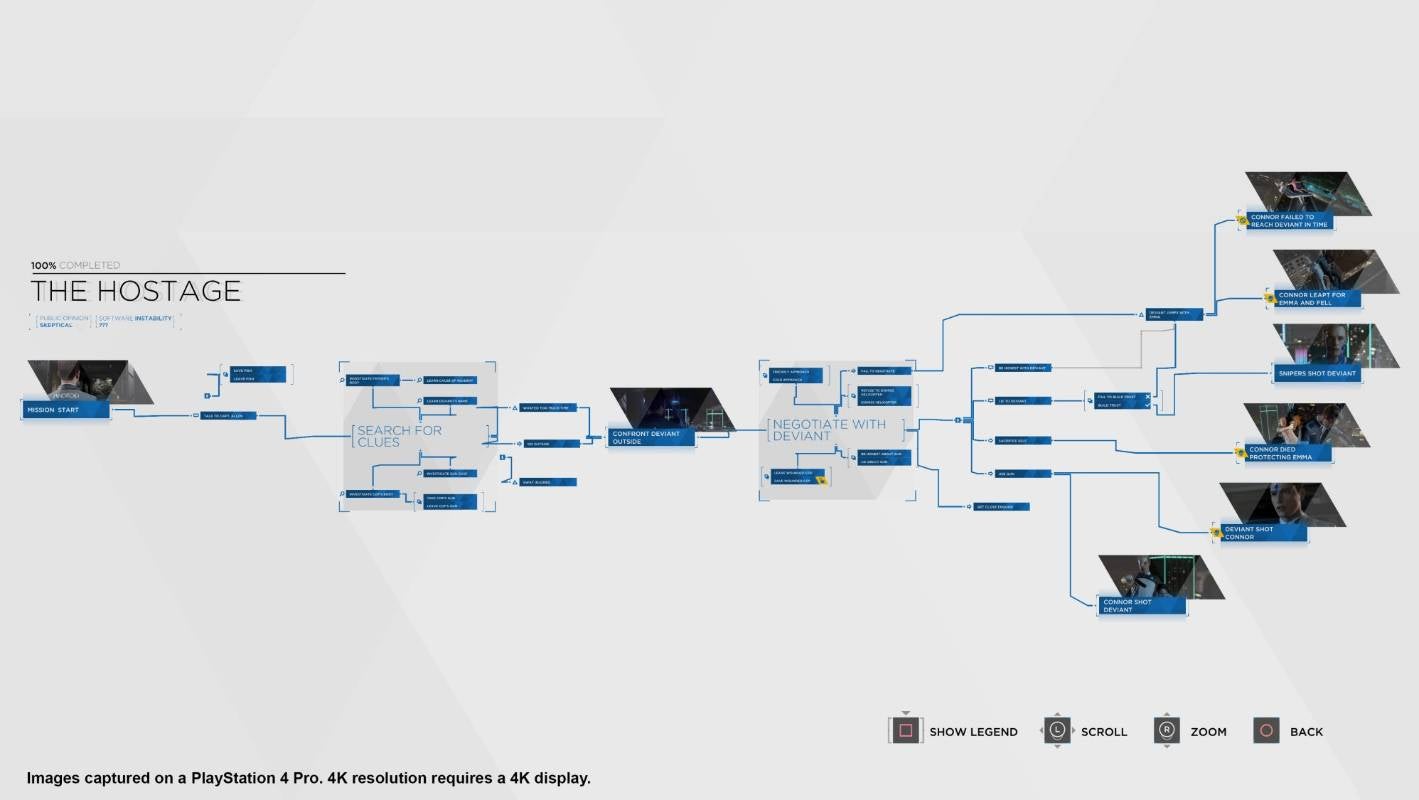
This is where sh*it starts to get crazy. What if there were copies of our orientation of the universe at an unreachable distance away? It is only inaccessible to us because we mentioned earlier that speed has a maximum of 299 792 458 meters/sec. It may simply just be a couple of too many billion years away. However, what if in this infinity resulted into the idea of a parallel universe, where there are infinite different decisions we could make going on simultaneouly in infinite time? Imagine our lives modeled as decision trees where we might have wanted to ask our crush how that decision can widely impact the subsequent sequences.
 |
|---|
| Video Game Decision Trees that can resemble decision trees in our own lives |
It is like the time stone and what they used in “Avengers Infinity wars.” So we can see that infinite permutations can occur within our own lives. The crazy thought is that those infinite decision paths are being executed, most likely in parallel at some distant spatial point… Crazy. And we can not see ourselves in a parallel universe as a millionaire or being reincarnated as a sheep because we are not in the proximity of our parallel universes where we infinitely exist in infinitely other spatial points. Bummer.
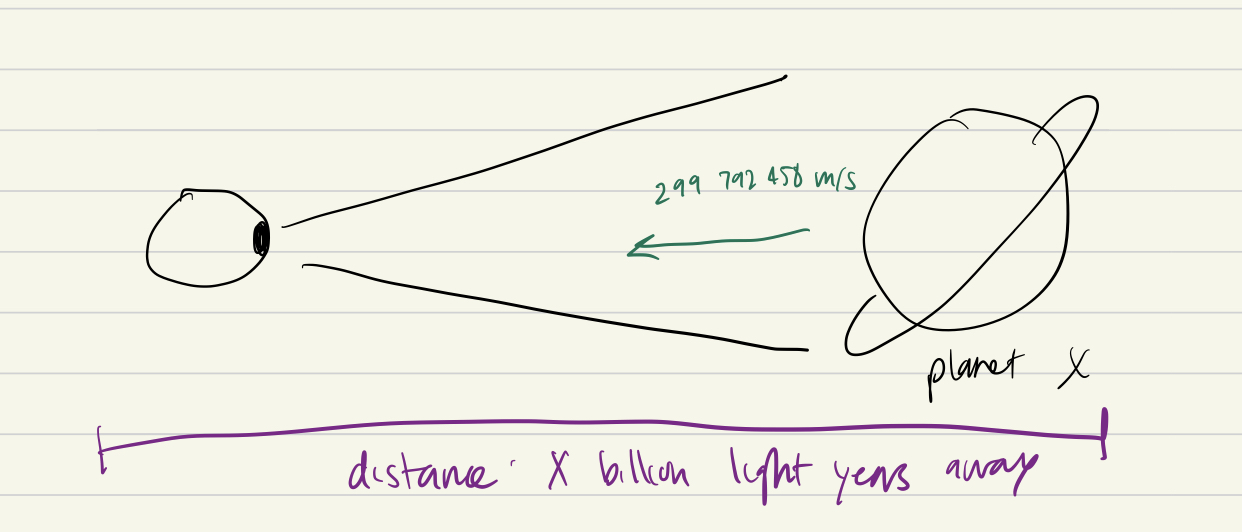
Now to those who do not believe me about the maximum value at which a thing can travel, I will present another example of the speed of light in action. The stars we see at night are minuscule because they are billions of light years away from the Earth. And so, every night we see the stars, these are image projections of where the planet was in the past. Because that star’s light traveled a billion light years in distance, by the time it reaches you, that star is definitely in a much farther position in space. Isn’t that a crazy thought in itself? If far enough, everything we see in the night sky is a past projection of where that star, comet, or planet was light years before. It is because light travels at a constant 299 792 458 meters/sec that it took us so long for us to able to perceive it.
 |
|---|
| A hand-drawn drawing of what our eyes perceive when we see planet X, in this case, |
Just a Spec in the Universe
Now that we know that light is the fastest thing in our universe, and even that is too slow, what does that make of us? If the universe is infinite, why even bother exploring other possible exo-planets that humans can inhabit? As someone who was a big supporter of space exploration as a kid, it also makes me wonder that this may be one of the most useless uses of our funds if they are not within a reachable point (i.e., our solar system). Even then, to get to Mars, or Jupiter’s moon, Europa, it would still take an incredible amount of time that is not worth it in the end.
This loss of hope in space exploration and trying to expand human beings to be multi-terrestrial raises the question: Does anything matter? All the damage humans have caused on Earth is pretty irreversible, and what has been done to preserve mother Earth? On the contrary, we are also just specks in this infinite universe living in an extremely short finite time interval. So, what are we trying to accomplish in our lives while we are here? This is where thinking too hard can lead to a downward spiral. If you think logically, there truly is no purpose to our lives, but I believe humans have been able to add meaning to this meaningless world.
As complex as the world is, humans are just as complex, and emotions are what personally sway me. Perhaps I can feel sentiment, anger, or happiness towards something, which makes life the way it is. We can go down all these loopholes about whether death is infinite or God is the concept of infinity, but we will save those for another time. However, I briefly wanted to discuss whether love is boundless (infinite). This may be a physical thing in our world that is an observable infinity. I want to believe it is but is it possible to love someone for the whole duration of your life? Throughout my short life, I have held onto a few friends for extended periods. I have met people that I want to love forever, but I guess this idea of whether love is infinite is subjective from person to person. So to answer it from my perspective, only time will tell.
So let’s go back to the theoretical side and ask, what if we went in one direction infinitely forever? Truth is just like the Earth; physicists believe the universe is some spherical shape. Therefore if we went in one order for an infinite amount of time, we would end up at the same place we started. However, physicists also believe that the universe’s shape is expanding at an accelerating rate which means that our galaxies are repulsing against one another. What this means for us is absolutely nothing. However, in the grand scheme of the feasible spacial domain, this may mean the timeline of life in the universe is finite. A universe will always exist, but life as we know it may cease to exist (predicted in 100 billion years). So life is just like us and living in a short time interval that won’t last forever. This makes life’s history short and infinity that much larger.
So what
The truth is that no one should care. A lot of theoretical physics and mathematics is being done purely to understand the universe we live in. I will conclude with one last thought. Are humans infinite? Will there be an infinite variety of human beings for the next 100 billion years? The answer is probably not, but there is no way to compare human beings due to their short life spans. However, I have reached this argument because, like the observable universe, our brains can only hold so many neurons. And these neurons can be intertwined in an exponential amount of ways, but this number is likely to be still finite. So based on everything that was discussed in this blog post, I believe that due to the limited amount of permutations of our brains, humans themselves also cannot be infinite.
So this leads me back to one last question: What is infinity?
Footnote
[1] Fourier Series - an infinite series of trigonometric functions representing an expansion or approximation of a periodic function.